
If you have made gains from Bitcoin, Ethereum, or other cryptocurrencies, those gains may be subject to tax. But, do not worry because making money from cryptocurrency does not automatically mean that you will face a large tax bill. In many cases, there are legal ways in which you can reduce what you owe.
When we talk about avoiding capital gains tax legally, we do not mean that you hide your crypto earnings from HMRC. There are rules already built into the system that you can use to bring down what you owe.

A crucial concept to know is that every time you sell, swap, or purchase using crypto currency, HMRC sees it as a taxable event. The days when we assumed that our crypto earnings are invisible to HMRC are long gone as their ability to track on-chain activity and exchange data is growing exponentially each year.
With proper planning, you can reduce your tax bill while staying fully compliant to HMRC rules and regulations. This guide will show you exactly how.
How Capital Gains Tax Applies to Cryptocurrency
Here’s something that catches many crypto investors off guard: HMRC doesn’t view your digital assets as traditional money. Instead, they treat cryptocurrency like property—think of it more like owning shares or a buy-to-let property than holding cash in a bank account.
This matters because it means most crypto profits are subject to Capital Gains Tax, not Income Tax.
When does CGT actually apply?
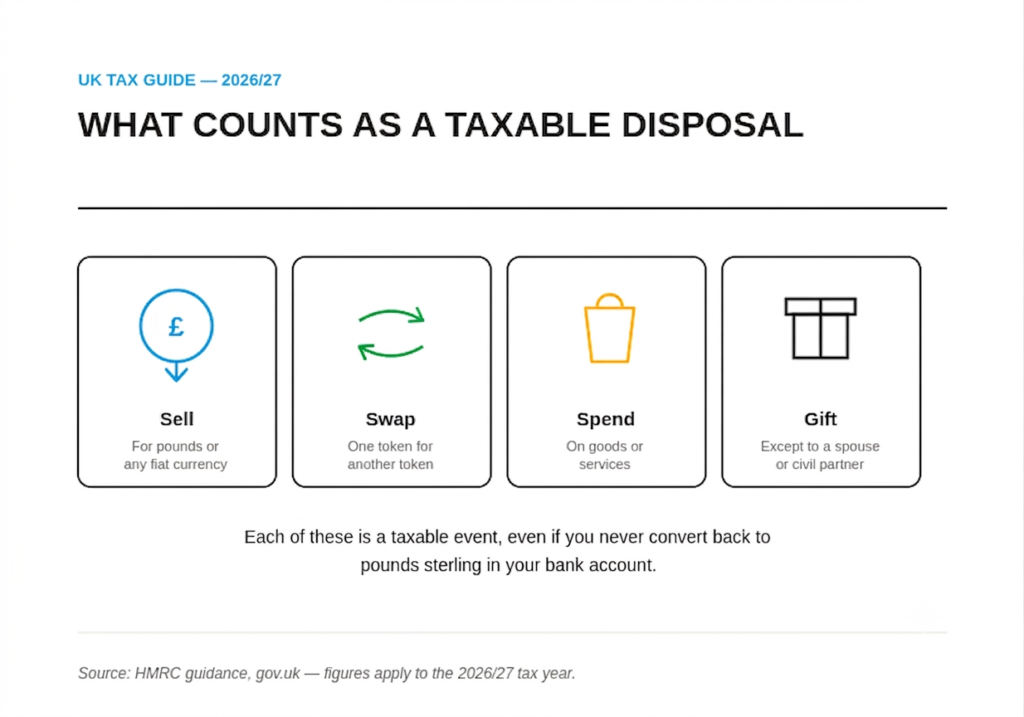
HMRC labels it as a “disposal”. A disposal occurs whenever you:
- Sell crypto for Pounds
- Swap one type of crypto currency for another
- Gift it to anyone who is not your spouse or civil partner
- Spend it to buy something
Each of these transactions requires you to calculate whether a capital gain (profit) or a capital loss was made, even if the money never touches your bank account.
What about Income Tax?
If you earn cryptocurrency through mining, staking or as payment for work, Income Tax is usually applicable instead of CGT.
The same goes for frequent trading. If HMRC views your activity as a business, you’ll also fall under Income Tax rules.
How Capital Gains on Cryptocurrency Are Calculated
Your gain is the difference between what the cryptocurrency was sold for and what you initially paid to buy it. You can also deduct certain costs known as allowable costs before calculating your profit. Allowable costs could include exchange fees or transaction fees.
Now, let’s say you bought Bitcoin five times, at five different prices. You might wonder, “Will HMRC make me track every single purchase separately?”
Thankfully, no. HMRC uses a method called Section 104 pooling. This means all purchases of the same cryptocurrency are grouped together into a single pool. HMRC then works out an average cost per token based on the total amount you paid. When you later sell, swap, gift, or spend some of your Bitcoin, that average cost is used to calculate your gain or loss.
But here’s where it gets a little technical.
Before HMRC lets you use that average price, they check two things:
- Did you buy the same crypto on the same day you sold it?
- Did you buy more of it within 30 days after selling?
If either of those applies, instead of using the average price, HMRC will first match those specific purchases to your sale. Only the remaining crypto is then matched against your average price pool.
Once you have added up all your gains for the year, the next step is to subtract your Annual Exempt Amount.
Think of this as a tax-free allowance. For the 2026/27 tax year, you can make up to £3,000 in gains before paying any Capital Gains Tax. Anything above this allowance will be subject to tax.

Ways to Reduce Capital Gains Tax on Cryptocurrency
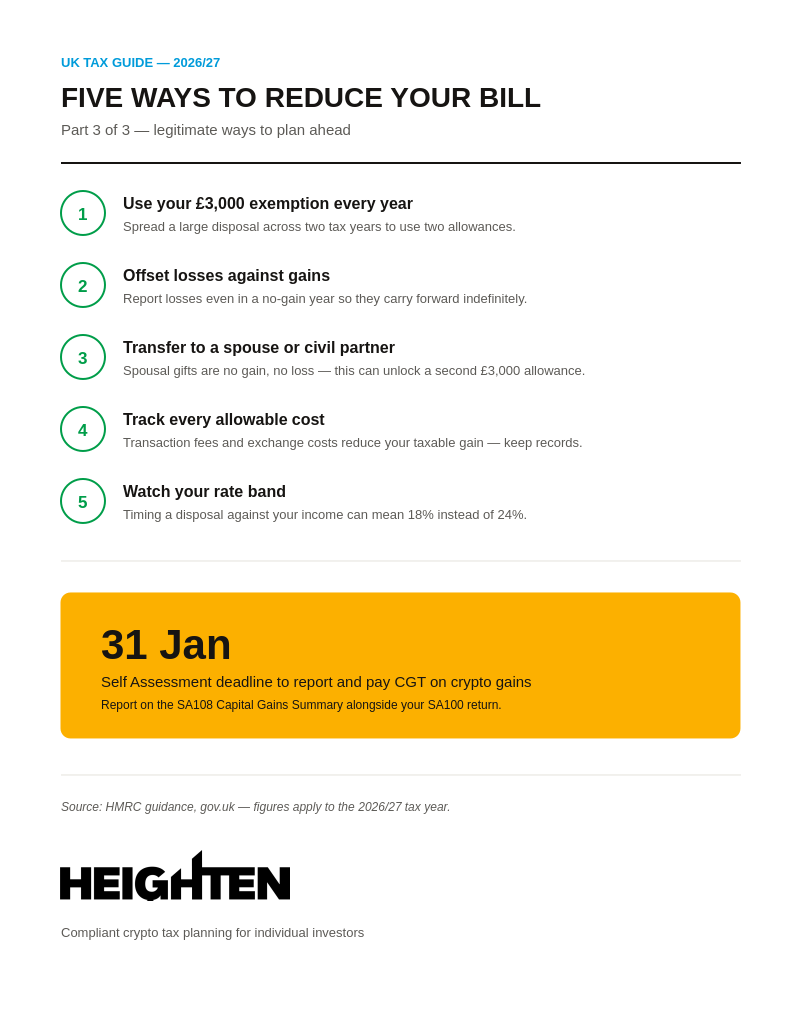
There are several legal and legitimate ways to bring down your tax bill.
1. Use your full £3,000 allowance every year.
This amount resets every 6 April, but there is a catch. If you do not use it, you lose it permanently as it does not carry forward. Therefore, if you are planning a big sale, consider splitting it across two tax years instead of cashing out all at once. This gives you two separate £3,000 allowances instead of one.
2. Offset your gains against your losses.
If some of your crypto investments have lost value, you can use those losses to cancel out your profits (gains). You can even carry unused losses forward to future years if you do not have any gains to offset this year. However, you must report your losses to HRMC, even in a year when you do not need them yet.
3. Transfer Crypto to Your Spouse or Civil Partner Before Selling
Did you know that transferring crypto to your spouse or civil partner is usually free from Capital Gains Tax? This can be a powerful tax-saving move. By gifting some crypto to your spouse or civil partner before selling, you can make use of both of your annual allowances.
This strategy is particularly effective if your partner has not used their Capital Gains Tax allowance or if they pay tax at a lower rate.
4. Keep track of every cost.
Good record keeping is essential. Costs you paid to purchase or sell your crypto, such as transaction fees and exchange fees, may be deducted when calculating your taxable gain, provided they qualify as allowable costs. If you have not started yet, we recommend you start record keeping immediately.
5. Timing disposals carefully across tax years.
The timing of your cryptocurrency sale can have an influence on your tax bill. Since HMRC calculates the capital gains tax based on the total gains each tax year, spreading sales over different tax years allows you to utilize your available tax-free allowance more effectively. This helps you avoid pushing your gains into a higher tax bracket in a single year.
When Capital Gains Tax Cannot Be Avoided
While there are legitimate ways to reduce your tax bill, there are limits to what you can achieve.
If your crypto trading becomes so frequent and organised that it resembles a business, HMRC may treat your gains as Income Tax rather than CGT. This could result in a significantly higher tax bill.
Another common pitfall is poor record keeping. Without proper records of what you originally paid for your crypto, calculating your profit becomes difficult. And if HMRC comes calling, you will struggle to prove your figures.
Reporting Cryptocurrency Gains Correctly
You must inform HMRC through a self-assessment tax return when your total gains for the year exceed £3,000. However, reporting is not based solely on your profit. You may also need to report if the total value of assets sold is high, even if your gain is small.
Here is how you report:
- Complete the SA108 form (Capital Gains Summary)
- Submit it alongside your main tax return, the SA100
- File online and pay any tax owed by 31 January following the tax year end
HMRC has introduced a dedicated section for cryptocurrency on the tax return, making the process more simple now.
You must record the following for HMRC:
- Dates of each transaction
- Values in pounds at the time
- The wallet or exchange used
- The reason for each transaction
What If You Have Unpaid Tax?
If you have undeclared crypto gains, HMRC offers a voluntary disclosure facility. This lets you come forward and declare unpaid tax on exchange tokens, NFTs, and utility tokens. Coming forward before HMRC contacts you can significantly reduce penalties.
It is advisable to make the disclosure before HMRC contacts you, as penalties can be much lower.
How many years you need to disclose depends on your situation:
- Up to 4 years if you took reasonable care
- Up to 6 years if you did not
- Up to 20 years if you deliberately misled HMRC
Common Misconceptions About Crypto Tax
There is a lot of misinformation floating around about cryptocurrency and tax. Let’s clear up three of the most common myths.
1. “Crypto is untraceable.”
This is one of the most persistent myths, but it is simply not true. Crypto is traceable. HMRC receives data from all major UK exchanges, and the rules have only gotten stricter . As of January 2026, a new set of rules called Crypto-Asset Reporting Framework (CARF) have been introduced which means all crypto platforms are obligated to share their identity and transaction data with HMRC. Over 50 countries are now sharing this information with each other.
2. “Swapping one crypto for another doesn’t count, because I didn’t get any cash.”
HMRC treats a crypto-to-crypto swap exactly like a sale. Even though no cash changed hands, you still need to calculate your gain or loss at the time of the swap.
3. “I only owe tax once I move money to my bank account.”
This is another common misunderstanding. Tax is triggered when you dispose of crypto, not when the money lands in your bank account. Selling, swapping, or spending crypto all count as disposals, regardless of whether you ever see the cash.
Planning Ahead for Crypto Investors
Taking a proactive approach to managing your crypto tax obligations is essential. Those who handle their crypto tax effectively tend to follow a few simple habits:
- They maintain clean, up-to-date records across all wallets and exchanges.
- They understand their tax position before they sell, not after.
- They treat their crypto assets as a core part of their financial life, not an afterthought.
With HMRC continually evolving its understanding of cryptocurrency activity and the annual allowance shrinking, it has never been more important to stay ahead of the curve.
HMRC keeps a close watch on your crypto gains now but that does not mean you are powerless. By making full use of your annual allowance, offsetting losses, transferring to your spouse, and keeping accurate records, you can legally reduce what you owe.
The key is to think ahead.
If you hold cryptocurrency and want to reduce your capital gains tax exposure while remaining compliant, Heighten Accountants can help you review your transactions and plan future disposals more effectively.
Please complete the form below so our team can contact you to arrange a consultation:
"*" indicates required fields





Leave a Reply